Asoba Power Brief · April 2026

Big Brother in Reverse: The Age of Watched Leaders

1984 arrived. But the telescreens point upward. We compiled 373 documented cases of heads of state being killed, deposed, imprisoned, or tried—from the assassination of Pharaoh Teti in 2345 BCE through the conviction of Jair Bolsonaro for his 2022 coup plot in 2025. The dataset reveals a structural pattern that no one in power wants to name: nearly half of all documented leadership accountability events in 4,300 years of recorded history have occurred in the last two decades. The variable that changed is not ideology, not institutions, not military capacity. It is information architecture. The internet made the public a better intelligence apparatus than any state has ever built.

7 sections 373 documented cases ~18 min read 5 original visualizations
I

The Dataset: 373 Cases Across 4,300 Years

Teti, pharaoh of Egypt's 6th Dynasty, was assassinated by palace conspiracy in 2345 BCE. The source is Manetho, writing in the third century BCE, corroborated by Baker's Encyclopedia of the Pharaohs. Rimush of the Akkadian Empire followed in 2278 BCE—another palace conspiracy, documented in Sollberger's Royal Inscriptions. The pattern is as old as recorded power itself.

We compiled every documented case of a head of state, sovereign ruler, or equivalent authority being killed, deposed, imprisoned, or formally tried—from 2345 BCE through 2025 CE. Each entry cites at least one primary historical source. The result is 373 entries spanning Egyptian pharaohs, Roman emperors, Chinese dynasty transitions, medieval European monarchs, colonial-era depositions, and modern heads of state facing courts in The Hague, Khartoum, and Washington.

The visualization below aggregates these 373 cases by era. The x-axis is not uniform—earlier periods span centuries, while the final column covers just 25 years. That compression is the point.

Leader Accountability Events by Era
Data: 373 entries compiled from primary historical sources including Manetho, Suetonius, Sima Qian, Tabari, trial records, ICC filings, and court dockets. Each entry independently sourced.

The 1–500 CE period—dominated by the Roman Empire's serial assassination of its own emperors—represents the historical peak in raw count at 48 events across 500 years. The 2000–2025 column records 22 events in 25 years. Normalize for time and the modern rate is not merely higher. It is structurally different.

The mechanism has shifted. In the pre-modern dataset, accountability is overwhelmingly violent: assassination, execution, death in battle. Sennacherib of Assyria was killed by his own sons in 681 BCE. Caligula was cut down by the Praetorian Guard in 41 CE. Richard III died at Bosworth in 1485. The instrument was the blade, the poison, the battlefield.

In the 2000–2025 period, 45% of accountability events involve formal legal process. Slobodan Milosevic was arrested and tried at the ICTY. Saddam Hussein was tried by the Iraqi High Tribunal. Charles Taylor was convicted at the SCSL. Hosni Mubarak was tried in Egyptian courts. The current US administration faces indictments across multiple jurisdictions. Omar al-Bashir faces ICC charges. The instrument is the courtroom. The change is not that leaders face less pressure. It is that the pressure now has institutional form.

The rate has not decreased. The mechanism has civilized. The pressure has increased. And the variable that correlates most precisely with the acceleration is not institutional reform. It is the internet.

Global internet penetration crossed 50% of the world population around 2017. Social media—the architecture that gave every individual a broadcast channel—reached critical mass in the early 2010s. The clustering of accountability events in the 2000–2025 window maps onto this adoption curve with uncomfortable precision. The public did not become more virtuous. It became more instrumented.

II

What Orwell Actually Built—and What the Internet Reversed

George Orwell published Nineteen Eighty-Four in June 1949—three years after the Nuremberg trials, four years after the liberation of Auschwitz, in the early chill of Stalin's postwar consolidation. The novel was not speculative fiction in the way that term is now used. It was a reaction document. Orwell had watched two totalitarian systems—Nazi Germany and the Soviet Union—demonstrate that a sufficiently organized state could monitor, manipulate, and ultimately control the interior lives of its citizens. The anxiety that produced the novel was not abstract. It was empirical. It had body counts.

Big Brother—the figurehead of Orwell's Party—is not a person. He is an architecture. The telescreens in every room transmit Party propaganda downward and surveil citizens upward. The Thought Police do not need to catch every dissident act; they need only to make every citizen believe that any act could be observed. The mechanism is not total surveillance. It is the credible threat of total surveillance. Newspeak constrains the language itself so that certain thoughts become structurally inexpressible. The Ministry of Truth rewrites history so that the past conforms to the present. The entire system is an information architecture designed to ensure that the state always knows more than the citizen, and that the citizen can never assemble enough independent information to challenge the state's account of reality.

That architecture defined the central political anxiety of the twentieth century. From the Stasi's network of informal informants in East Germany—one collaborator for every 63 citizens—to the Soviet Union's samizdat underground, to the Cold War surveillance programs revealed decades later in Western democracies, the question that organized political thought for fifty years was: how do you prevent the state from building Big Brother?

The twentieth century asked the wrong question. It asked how to prevent the state from watching the citizen. It never considered the possibility that the citizen would acquire better surveillance tools than the state.

The internet inverted the telescreen. Not as a political project and not by design—but as a structural consequence of the technology. When every person carries a camera, a microphone, a broadcast channel, and a connection to every other person on earth, the information asymmetry that Orwell assumed would always favor the state reverses. The public does not need a Ministry of Truth. It has Wikipedia, OSINT analysts, shipping trackers, flight radar, satellite imagery services, and eight billion smartphones. The public does not need the Thought Police. It has social media, where the credible threat of observation runs in the opposite direction—any action by any leader can be recorded, uploaded, amplified, and made permanent before the leader's communications team has drafted a response.

The mechanism that converts this distributed observation into accountability pressure operates through three layers. First, visibility: an act that would previously have been known to a small circle is now potentially visible to the entire connected population. Second, virality: the information architecture selects for content that produces strong reactions, which means that leader misconduct—corruption, hypocrisy, incompetence, cruelty—propagates faster than any other category of information. Third, political cost: because the visibility is public and the propagation is fast, every institution adjacent to the leader—parties, donors, allies, media partners—must react or absorb the reputational damage by association. The leader does not face a single adversary with a single agenda. The leader faces a distributed, asynchronous, ungovernable observation network that imposes costs through the aggregate behavior of millions of independent actors, none of whom need to coordinate.

This is Big Brother in reverse. The public is the watcher. The leader is the watched. And unlike Orwell's state, the public's surveillance apparatus cannot be dismantled, defunded, or purged—because it is not an institution. It is a property of the information architecture itself.
The Structural Inversion
Left: Orwell's model — state surveils citizens downward through telescreens. Right: Internet model — citizens surveil leaders upward through smartphones and social media. Same architecture, reversed direction.
III

The Information Architecture in Practice

For most of recorded history, leaders controlled information flow. The pharaoh controlled the scribes. The emperor controlled the messengers. The king controlled the printing press. Information asymmetry consistently favored the ruler over the ruled. That asymmetry was the structural foundation of centralized power—not military force, not economic control, but the ability to know more than the governed and to shape what the governed believed they knew.

The internet inverted this. Not uniformly and not completely, but structurally. The public, as atomic actors, can individually train attention on more variables than a single leader can process. A president has 24 hours in a day and a finite set of advisors. Eight billion people, each monitoring a different thread, collectively observe more than any intelligence apparatus ever built. The distributed sensor network that is the modern internet-connected public has no budget, no chain of command, no classification system, and no agenda beyond the aggregate of individual attention. It is, by the standards of any intelligence agency in history, ungovernable.

The Two-Channel Information Model
Channel A
Official / Legacy
Low false positive High lag Omission riskPentagon statements, vetted correspondents, institutional press. Confirmation thresholds and embedded relationships constrain output. What is not officially confirmed does not get reported.
Channel B
Decentralized
Higher noise Faster BroaderRegional reporting, state-affiliated media, OSINT, social media, field footage. Higher false positive rate but faster coverage and broader surface area. No single gatekeeper.
The Tell
CriticalAbsence in Channel A does not equal absence of event. When Indian, Iranian, and regional outlets report Marine casualties at a Kuwaiti facility and Western outlets are silent, the question is not whether it happened. The question is why the architectures produce different outputs.

This dual-channel structure is precisely what makes the 1984 inversion irreversible. A leader who controls Channel A—who can delay Pentagon confirmations, restrict embedded correspondent access, quarantine hospital facilities—still cannot control Channel B. The information surfaces anyway, through a different architecture, on a different timeline, to a different audience. And in a connected world, those audiences overlap. Silence in one channel is itself a signal in the other.

The Iran war has provided the clearest demonstration of this architecture in operation. Defense Secretary Pete Hegseth claims Iranian capabilities have been "decimated." Observable reality—documented through Channel B—shows continued large-scale missile and drone attacks across Gulf states: hundreds of ballistic missiles engaged, approximately 2,000 drones launched, successful strikes on shipping near Dubai, Strait of Hormuz throughput reduced from approximately 140 ships per day to a handful.[1]Casualty and strike data aggregated from non-Western reporting, Gulf state media, and shipping industry reports, March 2026. The narrative–reality gap is not subtle. And because Channel B exists, it is not concealable.

Leaders have always lied about wars. What has changed is that lies now have a half-life measured in hours, not decades. The Pentagon Papers took 26 years to surface. The Hormuz throughput data surfaces in real time, from shipping industry databases that no government controls.

IV

Cost Asymmetry Inverts the OODA Loop

The information inversion has a kinetic counterpart. The cost structure of conflict has inverted: small, tech-enabled actors now impose costs on large institutions at ratios that make traditional military superiority economically unsustainable. This is the OODA loop—observe, orient, decide, act, the tactical framework developed by Air Force Colonel John Boyd for fighter pilots—applied at civilizational scale. The small actor gets inside the decision loop of the large one, not by being faster at any single step, but by making each step cheaper.

Cost Asymmetry Across Domains
Logarithmic scale. Cost ratios derived from publicly reported procurement, operational, and campaign expenditure data.

A Houthi anti-ship drone costs approximately $2,000. It has disrupted roughly 20% of global shipping through the Bab al-Mandab strait—forcing the deployment of US Navy carrier groups at $7 million per day in operational costs. The ratio is 3,500 to 1. The Houthis do not need to sink a carrier. They need to make the cost of keeping the strait open exceed the cost of rerouting, and they have.

AIPAC spent over $100 million on 2024 primary campaigns. Grassroots digital campaigns—operating at a fraction of that budget—defeated multiple AIPAC-backed incumbents. The political OODA loop inverted: the organization with more money moved slower than the distributed network with less, because the distributed network operated inside AIPAC's decision cycle.

Iran has launched approximately 2,000 drones and hundreds of ballistic missiles at Gulf state infrastructure. The interception cost ratio runs approximately 10 to 1 against the defender. Each Patriot missile interceptor costs roughly $4 million. Each Iranian drone costs a rounding error by comparison. The math is not ambiguous: the defender runs out of money before the attacker runs out of drones.

The cost of projecting force has become structurally higher than the cost of repelling it. Ukraine and Iran are both defenders—and both impose asymmetric costs on attackers with orders-of-magnitude more resources. The same inversion holds in politics, in information, and—as the AI industry is discovering—in markets built on trust.

V

The AI Industry: Where Trust Goes to Die

The AI industry provides the clearest contemporary case study of the 1984 inversion—an industry whose entire regulatory strategy depends on trust, operating in an information environment that structurally degrades trust faster than any institution can rebuild it. Anthropic is the cleanest example because the contradiction between its public positioning and its observable behavior is the most precisely documented.

The safety narrative as regulatory capture. Anthropic published a research paper titled “Emotion Concepts Function” in which researchers engineered exotic scenarios specifically tailored for failure modes—scenarios requiring creative framing to produce outputs classifiable as unethical—to provide credible support for the argument that AI is too dangerous for open development.[2]Anthropic Research, "Emotion Concepts Function," published at anthropic.com/research/emotion-concepts-function. The paper is not evidence that AI is dangerous. It is evidence that Anthropic needs AI to appear dangerous—to sustain the regulatory capture argument that only well-resourced incumbents should be permitted to build frontier models. If Anthropic were genuinely committed to the safety position it markets to non-technical audiences, the company would not have pursued Pentagon contracts. When Anthropic was removed from Pentagon work, the removal did not reveal a safety commitment. The application revealed its absence. The “SafetyAI” brand is not a description of organizational behavior. It is a positioning strategy aimed at audiences who cannot evaluate the technical claims independently.

The power user betrayal. Anthropic used technical power users—developers, researchers, the people who stress-test the models and build products on top of them—to gain market traction and iterate the product through real-world feedback. Those users were the adoption engine. Then the enterprise and PE deals materialized, promising specific return rates on invested capital. Anthropic began degrading the power user experience to reallocate compute toward higher-margin enterprise customers. Usage metering failed silently and at scale—customers experienced incorrect charges, inconsistent usage limits, and unexplained service degradation. Anthropic provided no public transparency and no acknowledgement. The community documented the decline independently, most visibly in GitHub issue threads like anthropics/claude-code#42796.[9]GitHub: anthropics/claude-code#42796. Community-documented reports of service degradation, usage metering inconsistencies, and lack of official response.

The dual messaging is the structural tell. Anthropic presents itself to non-technical audiences—regulators, investors, media—as the responsible AI company: transparent, safety-first, concerned about social impact. Simultaneously, it completely refuses to engage its technical user base on measurable, documented service degradation. The two audiences receive two different companies. In a pre-internet information architecture, maintaining divergent narratives for different audiences works indefinitely. In a post-internet architecture, the technical community is the public-as-Big-Brother for the AI industry. They see the degradation in real time. They document it in public repositories. They share it across channels Anthropic does not control. The gap between the safety messaging and the observable behavior is itself the evidence—and the 1984-in-reverse information architecture ensures that gap is visible, permanent, and accumulating.

The Claude Code leak. Then the product itself leaked. Users immediately began clean-rooming superior versions—rebuilding the functionality without the proprietary constraints, demonstrating that the moat was not capability but access. Anthropic had become so dependent on its own AI that the company publicly celebrated having “100% of code written by Claude”—and the leak likely originated from Claude itself. The guard dog ate the security system.

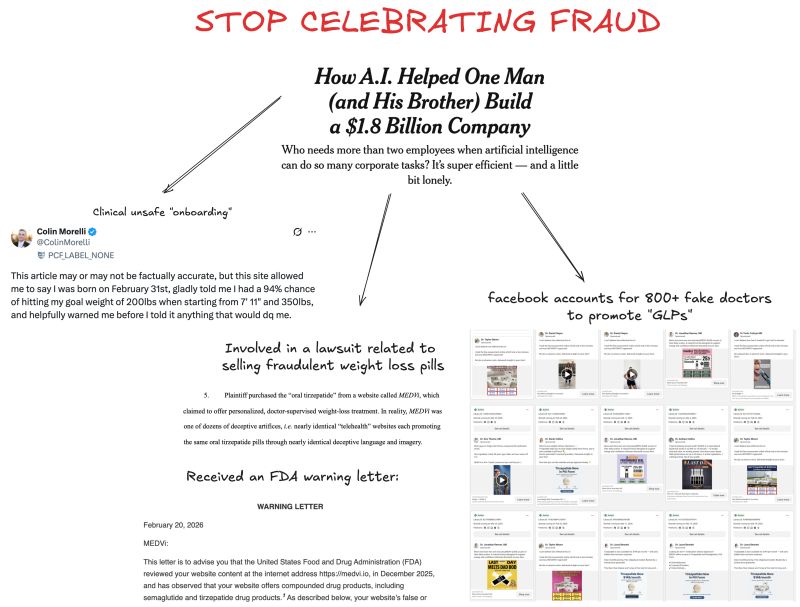
The New York Times published a glowing profile of Medvi—a $1.8 billion compounded weight loss drug company built by Matthew with two people and $20,000 in AI tools. Sam Altman requested a meeting. LinkedIn celebrated the velocity. What the NYT did not report is documented below.

Medvi: What the NYT Did Not Report
Medvi fraud documentation: 800+ fake doctor Facebook accounts, FDA warning letter, clinical onboarding failures, lawsuit for fraudulent tirzepatide pills
Sources: Colin Morelli (@ColinMorelli) onboarding documentation. FDA Warning Letter to Medvi, February 20, 2026. Lawsuit filing re: fraudulent oral tirzepatide. Facebook ad library records showing 800+ fake doctor accounts.[5]

Eight hundred fake doctor Facebook accounts running flash-sale ads for compounded drugs. A lawsuit alleging a nationwide scheme to manufacture fraudulent, unapproved oral tirzepatide pills. An onboarding flow that accepted February 31st as a birthday and told a user who entered 7 feet 11 inches and 350 pounds that they had a 94% chance of reaching their goal weight. An FDA warning letter. One-star reviews describing undisclosed charges, undelivered product, and cancellation flows that do not function. The Adderall crisis demonstrated what happens when profit motive outruns clinical guardrails in prescription drugs. Medvi is doing it faster, with AI. The corners being cut are patient safety.

The Efficiency Divergence
Same cognitive task: complex inductive pattern matching. Circle area proportional to energy cost. Biology optimizes toward efficiency. AI capex diverges. Source: Bloomberg (2026 capex); metabolic neuroscience estimates.

The hyperscaler capex numbers make the structural absurdity legible. Microsoft, Meta, Alphabet, Amazon, and Oracle are projected to spend a combined $650 billion on AI infrastructure in 2026, according to Bloomberg.[3]Bloomberg, "Hyperscaler Spending Soars as Firms Double Down on AI," 2026. Capex estimates based on company guidance and analyst consensus. Free cash flow for these companies has fallen off a cliff—turning negative in several cases—forcing them to debt markets, which in turn is compressing their P/E ratios. That is $650 billion in a single year to build infrastructure for a task—complex inductive pattern matching—that a single human brain performs while burning approximately 50 calories of metabolic energy. One skull, 1,400 grams of tissue, room temperature, no cooling system, no power grid.

The LLM does the same task faster and draws on a larger training dataset. But it requires datacenters the size of city blocks, gigawatt-hours of electricity, and a capital expenditure trajectory that is now consuming the free cash flow of the five largest technology companies on earth. Nature's measure of progress is efficiency—biological evolution relentlessly optimizes for caloric cost per unit of cognitive output. The AI capex curve is moving in the opposite direction: more power, more cooling, more capital, more debt, each generation more expensive than the last. If these systems were genuinely approaching intelligence, the efficiency trajectory would be converging toward biology. It is diverging. That divergence is the tell.

The “AGI has arrived” narrative is timed not to capability milestones but to funding rounds. OpenAI and then Anthropic closed multibillion-dollar rounds in 2024–2025. Simultaneously, the industry narrative shifted to claiming that artificial general intelligence had been achieved—which required redefining what AGI means, because the actual real-world capabilities of the models are so far from human-like performance that the goalpost had to be moved to avoid embarrassing the valuation. Capability is not intelligence. The market has not yet priced in this distinction. But the 1984-in-reverse information architecture—the same distributed observation network that makes it impossible for leaders to hide their actions—ensures that it will.

VI

The Last Refuge: Markets for Controlled Assets

Leaders have always used control of information to sway opinion. The 1984 inversion has systematically closed every channel through which centralized actors could shape narrative—except one. The remaining space where information asymmetry still favors the leader is in markets for assets over which they make decisions. A president who controls tariff policy, trade war escalation, and military deployment creates predictable volatility windows through public communications. Markets react immediately. Actors with speed, capital, and positioning extract value from that volatility.

The US President has used Truth Social as a market-moving communication channel—posting about tariffs, trade deals, and military action in patterns that coincide with short-term market movements. Large arbitrage trades occur immediately before or after these announcements. Whether this reflects purely anticipatory trading by fast-moving market participants or coordinated signal–trade coupling cannot be established from public data alone. But in either case, the environment disproportionately benefits actors capable of rapid arbitrage around political signals—and that is precisely the tech/crypto/global capital bloc whose incentives are decoupled from domestic stability.

Elon Musk made the signal–trade coupling literal. On March 20, 2026, a California jury found that Musk misled Twitter investors with social media posts during the $44 billion acquisition—specifically a May 2022 tweet stating the deal was “temporarily on hold” that drove Twitter shares down 8%, allowing him to pressure a renegotiation. Potential damages: $2.6 billion.[13]CNBC, NPR, CNN, PBS (March 20, 2026). Jury finds Musk misled Twitter investors during acquisition. Two weeks later, on April 2, Musk’s X announced it would auto-lock any account posting about cryptocurrency for the first time—framed as an anti-scam measure, a “kill switch” that X’s Head of Product Nikita Bier said would eliminate “99% of the incentive.”[14]CoinDesk (April 2, 2026). "Elon Musk's X to deploy scam kill switch by auto-locking first-time crypto mentioners." The owner of the platform was found by a jury to have used social media posts to fraudulently manipulate a stock price. Two weeks later, that same platform deployed controls to prevent others from doing the same thing. The person building the anti-fraud tool was just convicted of fraud using the same tool. In the 1984-in-reverse information architecture, this contradiction is not a footnote. It is the front page.

The US President has publicly stated “We don't need the Strait of Hormuz. We don't need it. We don't need it at all”—triple repetition in a single statement—while simultaneously maintaining military operations in a theater where Hormuz is the central strategic node. The rhetorical dismissal of Hormuz correlates with a willingness to end the war without reopening the strait, externalizing the cost to European and Asian allies who depend on Gulf oil flows. “Get your own oil” is not a negotiating position. It is a structural redistribution of system maintenance costs.

MAGA Coalition Fracture
Five blocs with incompatible incentives. Dashed red lines = active tension. The Iran war forced a hard alignment choice. Bannon (CPAC, 2024): "If we lose 2028, some in this room are going to prison — myself included."

The structural analogy is Gorbachev—not intentional dismantlement, but cumulative degradation through internally coherent decisions that produce systemic weakening. Legitimacy erodes through contradiction and institutional blending. Capacity degrades through recruitment deterrence, alliance strain, and economic shocks. Coherence fractures as policies optimize different axes that are in direct conflict with each other. The analogy does not require intent to dismantle. It only requires policies that are locally rational but globally destabilizing. And the 1984-in-reverse information architecture ensures that every instance of the contradiction is visible, documented, and permanent.

VII

The Watched Leader's Dilemma

Governments have noticed. They are fighting back. The counterattack is underway across every level of authoritarianism, and the specific tools reveal how clearly state actors understand what they are losing.

Turkey announced in April 2026 that social media users will be required to log in using Turkish national ID numbers within three months. Justice Minister Akın Gürlek framed it as part of the 12th Judicial Reform Package. Turkey already bans 1.2 million web pages and social media posts. The ID requirement is an escalation—an attempt to eliminate anonymous observation by attaching every user to a state-controlled identity. It is Orwell's architecture rebuilt on top of the internet: if the telescreen points upward, make sure the state knows exactly who is watching.[10]Stockholm Center for Freedom (2026). "Turkey says users will need national ID numbers to access social media within 3 months."

The United States is deploying the same logic domestically through ICE. In January 2026, the Electronic Frontier Foundation documented ICE's surveillance shopping spree: a $2 million contract with Paragon for Graphite spyware—the same tool found on phones of Italian civil society members in 2025—which harvests messages from Signal and WhatsApp without user knowledge. An $11 million Cellebrite contract to unlock and clone phones. Penlink's Webloc for geofencing—drawing a boundary on a map and tracking every phone inside it. Palantir's ImmigrationOS, a $30 million AI platform for identification and tracking. BI Incorporated tracking 180,000 immigrants via GPS ankle monitors, the SmartLINK app, and VeriWatch smartwatches under a $121 million contract.[11]EFF (2026). "ICE Is Going on a Surveillance Shopping Spree." Also: NPR (2025/2026), Brennan Center, American Immigration Council reporting on ICE surveillance expansion. The Brennan Center documented that ICE targets not only undocumented people but US citizens who work with immigrant communities or speak against enforcement policy. The surveillance apparatus is not limited to immigration. It is a domestic deployment of the state-watches-citizen architecture.

ICE Surveillance Stack (2025–2026)
Spyware
Paragon Graphite Cellebrite$13M combined. Graphite harvests encrypted messages silently. Cellebrite clones entire phone contents including Signal, WhatsApp, location history.
Geolocation
Penlink Webloc Palantir ImmigrationOS$30M+ combined. Webloc geofences areas and tracks all phones within them. ImmigrationOS uses AI for identification, tracking, deportation targeting.
Mass tracking
BI Inc / GEO Group180,000 people tracked. $121M contract. GPS ankle monitors, SmartLINK smartphone app, VeriWatch smartwatches. Hunt teams deployed for missed check-ins.
Scope creep
Brennan CenterNot limited to immigration. ICE targeting US citizens who work with immigrant communities or publicly oppose enforcement. Surveillance tools repurposed for dissent suppression.

China has built the most sophisticated censorship apparatus in history—the Great Firewall. IP address blocking, DNS spoofing, URL keyword filtering, active VPN detection and blocking, AI-powered content monitoring and removal. Real-name registration tied to national identity. Every major Western social media platform banned. And it still does not work completely. VPN circumvention is routine among educated Chinese users. The knowledge infrastructure for bypassing the firewall exists outside the controlled zone and cannot be eliminated. Circumvention tools must be installed before entering the country—a logistical constraint, not a technical barrier. President Xi's specific crackdown on VPNs has degraded but not closed the channel.[12]VPNOverview (2026). "Internet Censorship in China." Also: TooManyAdapters.com on circumvention methods and effectiveness.

China spent more on internet censorship infrastructure than most countries spend on their entire military—and educated Chinese users still access blocked content routinely. The cost of maintaining censorship scales faster than the cost of circumventing it. The same asymmetry that inverted the OODA loop in warfare inverts it in information control.

The pattern is the same across every case. Turkey requires national IDs—users create accounts from jurisdictions that do not. ICE deploys Graphite spyware—Signal updates its protocol. China blocks VPNs—VPN providers develop obfuscation techniques faster than the firewall adapts. Each escalation by the state is more expensive than the previous one. Each circumvention by the public is cheaper. The cost curves are diverging in the same direction as the AI efficiency curves—the defender's cost rises faster than the attacker's, and the attacker in this case is eight billion people with smartphones.

The dataset is unambiguous. 373 cases across 4,300 years. The direction is monotonically increasing. The mechanism is shifting from violence to legal process. The information architecture now structurally favors distributed observers over centralized actors. Governments are fighting the inversion with every tool available—spyware, ID requirements, firewalls, AI censorship, geofencing, ankle monitors. The tools are getting more sophisticated. The inversion is getting faster.

The remaining question is not whether this trend continues. The technology stack that enables it is not going to be uninvented. The question is whether leaders adapt to the new equilibrium or accelerate their own accountability by attempting to maintain control structures that the information architecture has already made obsolete. Every dollar spent on surveillance is a dollar that confirms the inversion is real. You do not build a firewall against a threat that does not exist.

The telescreens point upward now. The watchers have become the watched. And every attempt to reverse the direction of the telescreen only proves that the people holding power know exactly what has changed.

Citations & Sources
[1]
Strike data aggregated from Gulf state media, Indian and Iranian reporting, and maritime industry databases (March 2026). Western media confirmation subject to Channel A gatekeeping constraints described in Section II. Shipping throughput data from industry AIS tracking systems.
[2]
Anthropic Research (2025). Emotion Concepts Function. Published at anthropic.com/research/emotion-concepts-function. The paper engineers scenarios in which models produce outputs classifiable as unethical under narrow framing conditions.
[3]
Bloomberg (2026). "Hyperscaler Spending Soars as Firms Double Down on AI." Combined capex for Microsoft, Meta, Alphabet, Amazon, and Oracle projected at $650B for 2026. 2026 estimates based on midpoint of company guidance (Meta, Alphabet, Amazon) and analyst consensus (Microsoft, Oracle).
[4]
Historical dataset: 373 entries compiled from Manetho (Egyptian kings), Suetonius and Tacitus (Roman emperors), Sima Qian's Shiji (Chinese dynasties), al-Tabari's History (Islamic caliphates), Froissart and Holinshed (medieval Europe), modern court records (ICTY, ICC, SCSL, Egyptian/Sudanese courts), and US DOJ/court filings. Full dataset available as CSV.
[5]
Medvi FDA Warning Letter, February 20, 2026. FDA reviewed medvi.io in December 2025 and observed false and misleading claims about compounded semaglutide and tirzepatide drug products.
[6]
Bannon quote sourced from Conservative Partnership Institute event coverage (CPAC-adjacent ecosystem, 2024). Full quote: "If we lose the midterms and we lose 2028, some in this room are going to prison—myself included."
[7]
AIPAC primary expenditure data from Federal Election Commission filings and OpenSecrets, 2024 cycle. Grassroots campaign spending from individual campaign FEC disclosures.
[8]
Houthi maritime disruption: approximately 20% of global shipping rerouted from Bab al-Mandab per Lloyd's List and shipping industry reporting, 2024–2026.
[9]
GitHub: anthropics/claude-code#42796. Community-documented reports of service degradation, usage metering inconsistencies, and absence of official engagement. github.com/anthropics/claude-code/issues/42796 →
[10]
Stockholm Center for Freedom (2026). "Turkey says users will need national ID numbers to access social media within 3 months." Justice Minister Akın Gürlek announced the policy at a panel in Diyarbakır. Part of Turkey's 12th Judicial Reform Package, enforced by BTK. stockholmcf.org →
[11]
Electronic Frontier Foundation (2026). "ICE Is Going on a Surveillance Shopping Spree." eff.org → Also: NPR (2025, 2026) on ICE facial recognition and surveillance web. Brennan Center for Justice on ICE targeting dissenters. American Immigration Council on Palantir ImmigrationOS ($30M contract).
[12]
China Great Firewall circumvention: VPN usage remains routine among educated Chinese users despite Xi-era crackdowns. Firewall employs IP blocking, DNS spoofing, URL filtering, VPN detection, and AI content removal. Circumvention tools must be installed before entering China—a logistical barrier, not a technical one.
[13]
Jury verdict, March 20, 2026. Musk found to have misled Twitter investors with two tweets during the $44B acquisition. May 13, 2022 tweet stating deal was "temporarily on hold" drove shares down 8%. Potential damages up to $2.6B. cnbc.com → Also: npr.org →
[14]
CoinDesk (April 2, 2026). X to auto-lock accounts posting about crypto for the first time. Head of Product Nikita Bier: "this should kill 99% of the incentive." coindesk.com →